

 ·
3 minute read
·
3 minute read
Examining how in-store, online, and mobile payment experiences have evolved to support changing customer expectations.
Payment acceptance has changed significantly over the past several decades. What was once centered primarily around cash transactions and physical point-of-sale terminals has expanded to include eCommerce platforms, mobile devices, digital wallets, and integrated payment experiences.
This article explores the evolution of payment acceptance across in-store, online, and mobile channels, the factors influencing these changes, and how businesses are adapting to an increasingly connected payment landscape.
Consumer purchasing habits have expanded beyond traditional brick-and-mortar environments. Customers now interact with businesses through multiple channels and often expect payment options that align with their preferred shopping experience.
Several factors have contributed to this evolution:
- Growth in digital commerce
- Increased use of smartphones and mobile devices
- Expansion of contactless payment technologies
- Greater adoption of digital wallets
- Demand for more convenient checkout experiences
As these trends continue to develop, organizations often evaluate how payment acceptance supports both customer interactions and operational processes.
For many years, payment acceptance was largely limited to cash, checks, and card transactions processed through standalone terminals.
Characteristics of traditional payment environments included:
- In-person transactions
- Physical payment cards
- Manual reconciliation processes
- Limited visibility across payment activities
As payment technologies advanced, businesses began adopting systems that could support faster transaction processing and improved operational efficiency.
The expansion of eCommerce introduced new opportunities for businesses to accept payments beyond physical locations.
Online payment acceptance enabled organizations to:
- Reach customers through websites and digital storefronts
- Support remote purchasing experiences
- Offer electronic billing and invoicing
- Facilitate recurring payment arrangements
Payment acceptance requirements often vary by industry, with organizations evaluating different approaches based on operational needs and customer interactions. To explore examples across sectors, visit our Tempus Products & Services.
The widespread use of smartphones introduced another payment channel: mobile commerce.
Today, mobile payment experiences may include:
- Mobile wallet transactions
- Payments through business applications
- Mobile point-of-sale devices
- Tap-to-pay functionality
- Contactless transactions
Mobile payment capabilities have expanded payment acceptance beyond traditional retail environments, allowing businesses to process transactions in a variety of locations.
Common applications include:
- Field service operations
- Events and trade shows
- Temporary retail locations
- Delivery and transportation services
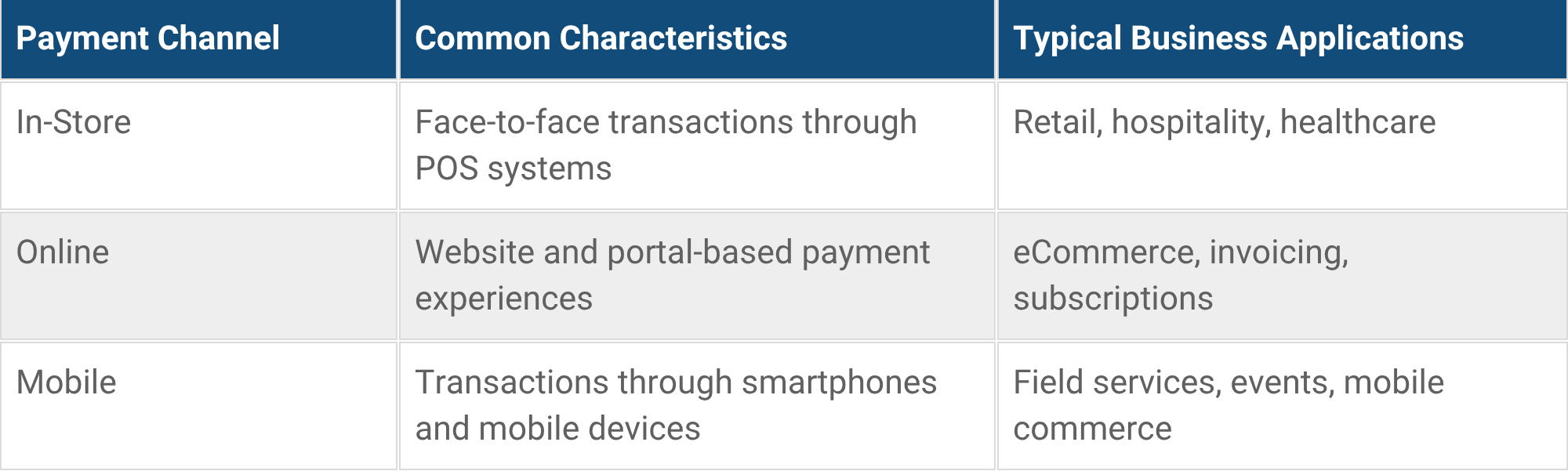
While each channel supports different customer interactions, many organizations use multiple payment channels as part of their overall payment acceptance strategy.
As businesses expanded into multiple channels, managing payments across separate systems became increasingly complex.
Organizations often sought greater visibility into:
- Transaction reporting
- Customer payment activity
- Reconciliation processes
- Operational workflows
This shift contributed to the adoption of more connected payment environments that support payment acceptance across multiple channels through centralized systems. Organizations evaluating these approaches may explore Tempus Industries that support transaction processing, reporting, and operational workflows.
Omnichannel payment acceptance refers to the ability to support transactions across multiple customer touchpoints while maintaining consistency throughout the payment experience.
Examples may include:
- A customer browsing online and completing a purchase in-store
- A retailer accepting payments through a website and mobile application
- A service provider processing payments in the office and in the field
The goal of omnichannel payment acceptance is to support customer interactions regardless of where a transaction occurs.
Retail businesses often process transactions through physical stores, websites, and mobile channels to support a range of purchasing preferences.
Healthcare organizations may accept payments through patient portals, in-office payment locations, and mobile devices used by staff.
Educational institutions frequently offer online payment portals while also supporting in-person payment options for students and families.
Professional service organizations may use online invoicing, recurring billing, and mobile payment acceptance to support client interactions.
Nonprofits often accept payments and donations through websites, events, mobile devices, and recurring giving programs.
Payment technologies continue to evolve alongside customer expectations and digital commerce trends.
Areas receiving increased attention include:
- Digital wallet adoption
- Embedded payment experiences
- Mobile-first customer interactions
- Subscription and recurring payment models
- Integration between payment systems and business operations
As payment channels continue to expand, organizations often evaluate how these developments align with customer engagement and operational objectives.
-
Payment acceptance has evolved from primarily in-person transactions to include online and mobile channels.
-
Customer interactions increasingly occur across multiple touchpoints.
-
In-store, online, and mobile payment experiences serve different purposes within the customer journey.
-
Many organizations support multiple payment channels to accommodate varying purchasing preferences.
-
Connected payment systems can provide greater visibility across transaction activity and payment operations.
-
Payment technologies continue to evolve alongside changes in commerce and customer behavior.
Understanding the evolution of payment acceptance across business channels can help organizations evaluate how payment technologies support customer interactions, operational processes, and the broader commerce experience. Organizations interested in learning more about payment acceptance technologies can contact us for additional information.